Pool cleaning sounds straightforward. Remove leaves. Pick up dirt. Keep the floor clear. But real pools are rarely simple. Many home pools have curves, slopes, steps, benches, and ledges. These details look great. They also create more places for debris to hide.
Cleaning coverage is the real problem. It is not just about power. It is about where the cleaner goes. A device can have strong suction and still miss key areas. This is why smart navigation matters so much. It helps a robotic cleaner move with purpose. It also helps it cover more of the pool with less wasted motion.
Smart navigation is not a “nice to have” feature. For many pool shapes, it is the difference between “mostly clean” and “consistently clean.”
Why pool shape changes everything
Debris does not land evenly. It drifts. It sinks. It collects in patterns. Those patterns depend on the pool’s shape and circulation.
A rectangular pool has predictable zones. Corners trap dirt. Long walls guide the flow. A freeform pool behaves differently. Curves create slow-water pockets. Steps create small eddies. Ledges catch fine particles and oils.
Manual cleaning can handle these areas. But it takes time and attention. Basic automated cleaners may not handle them well. Many rely on random movement. Random movement can work in small pools. It often struggles in complex layouts.
The more complex the pool, the more important navigation becomes.
What smart navigation actually does
Smart navigation is about control and decision-making. The cleaner uses sensors and internal logic to guide movement. It does not just wander. It tries to plan coverage.
Different systems use different methods. The goal is similar. Improve coverage. Reduce repeats. Avoid getting stuck.
Smart navigation can help the cleaner:
- Map or “understand” boundaries through repeated sensing
- Adjust direction when it hits walls or curves
- Maintain straighter cleaning lines on open floors
- Reorient after climbing or turning
- Spend less time looping in one zone
Even without a perfect “map,” smarter pathing improves consistency. You get more of the pool cleaned in a single cycle.
Rectangular pools still benefit from smart routes
A rectangular pool seems easy. But random cleaners often over-clean the center. They may under-clean edges. They may bounce in short zigzags.
Smart navigation helps here in a simple way. It supports more structured passes. It also reduces overlap.
That matters for everyday use. Dust and sand often collect along the perimeter. Fine debris settles where the floor meets the wall. A cleaner that follows better routes reaches these zones more reliably.
You also tend to see more consistent wall contact. That helps with light film on walls. It also helps near the waterline, depending on the cleaner’s design.
Freeform pools need adaptive movement
Freeform pools are the real test. Curved walls can confuse basic pathing. The cleaner may turn too early. It may get trapped in a “loop.” It may avoid tight curves and keep returning to open areas.
Smart navigation improves this by adapting. It can correct direction after a curve. It can push into irregular sections instead of bouncing away. It can avoid repeating the same arc over and over.
This is where coverage gains become obvious. Over time, the cleaner spends less time “searching.” It spends more time cleaning.
If your pool has a kidney shape, rounded bays, or sweeping curves, navigation matters more than most people expect.
Steps, ledges, and benches are coverage traps
Many pools have features that sit between the floor and the wall. Steps. Tanning ledges. Built-in benches. These areas collect debris fast. They also create edges that can stop a cleaner’s momentum.
A non-smart cleaner may climb onto a ledge and stall. Or it may avoid the ledge and keep cleaning the open floor. Either way, coverage suffers.
Smart navigation helps reduce these problems. It can detect a boundary. It can back out cleanly. It can try a new angle. It can spend time around a feature without getting stuck there.
This leads to more even cleaning. It also reduces the need for manual touch-ups after each cycle.
Better navigation means fewer missed zones
Missed zones are not always obvious. A pool can look clean at a glance. Then you see dirt lines in corners. Or a dusty strip along one wall. Or small piles near a drain.
These are often not “power” problems. They are path problems.
Smart navigation reduces missed zones by improving distribution of time and movement. The cleaner is less likely to ignore one side of the pool. It is less likely to spend 30 minutes repeating the same patch of floor.
Over weeks, this consistency matters. It helps keep dirt from building up in the same places. It also helps keep water clearer because less debris is left behind to break down.
Why smart navigation feels more convenient day to day
Convenience is not only about pressing a button. It is about trust. You want to feel confident that a cycle will actually cover the pool.
When navigation is smarter, you usually see:
- More predictable results from cycle to cycle
- Less need to restart “just in case”
- Less manual brushing in corners and around steps
- Fewer surprise dirty patches before guests arrive
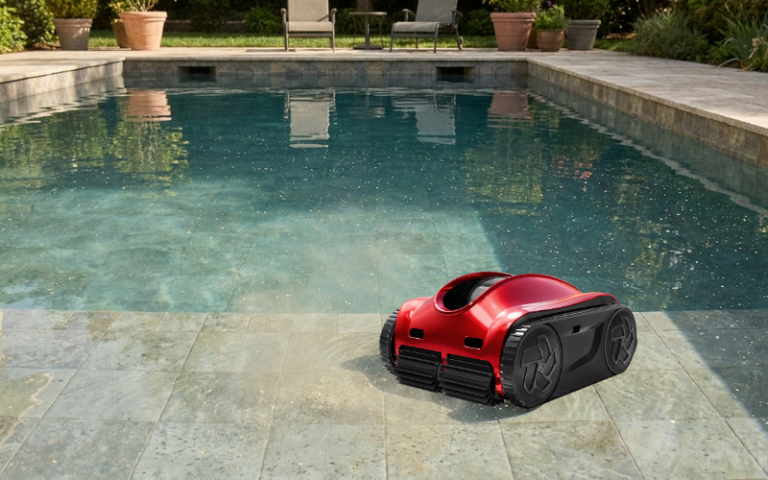
This is where a smart-navigation-focused model becomes relevant in a natural way. If you are comparing options and your priority is coverage across mixed shapes, a cleaner designed around intelligent pathing fits that need. For example, the iGarden Robotic Pool Cleaner is built around smart navigation, which supports more consistent coverage across floors and walls in pools that are not perfectly simple.
How to judge if your pool needs smart navigation
Not every pool needs the same level of navigation. But many home pools benefit from it.
Smart navigation tends to matter most when you have:
- A freeform or curved pool shape
- Multiple steps and ledges
- Benches or shallow lounging areas
- Frequent debris drift into corners
- A desire to reduce manual spot-cleaning
If your pool is small and simple, basic movement may be enough. If your pool has features and irregular zones, navigation becomes a key performance driver.
The real value is consistent coverage
Smart navigation improves cleaning coverage by reducing randomness. It helps a robotic cleaner spend time where it should. It helps it reach tricky zones. It helps it avoid wasted loops.
For home use, that is the goal. You want reliable results. You want fewer missed areas. You want less manual correction.
Pool shapes are getting more creative. Cleaning needs to keep up. Smart navigation is one of the clearest ways it does.
About the Author